Sequenzy vs ActiveCampaign: Automation, CRM and Cost
Sequenzy vs ActiveCampaign for email sequences: automation depth, CRM and deals vs billing-event email, with costs at 1k, 5k and 10k subscribers.
ActiveCampaign suits sales-led, CRM-linked automation: a team whose reps work deals in a pipeline and whose emails should follow what happens to those deals. Sequenzy suits SaaS teams that bill through Stripe, Paddle or Lemon Squeezy and want subscription events, such as a failed invoice, to start the email. They also price differently, ActiveCampaign by contacts with a send allowance and Sequenzy by emails sent with unlimited contacts. Below: automation depth, CRM, costs for 1,000, 5,000 and 10,000 subscribers, and what moving in either direction involves.
ActiveCampaign's pricing page lists Starter at $15 a month for 1,000 contacts, billed annually. Sequenzy's pricing page lists a free plan at 2,500 emails a month and a $19 plan at 15,000.
The two products side by side
| Sequenzy | ActiveCampaign | |
|---|---|---|
| Built around | Billing- and event-triggered email for SaaS | Marketing automation with a CRM attached |
| What the price follows | Emails sent a month; unlimited contacts and sending domains | Contacts selected; sends allowed up to 10x the contact limit on Starter and Plus, 12x on Pro, 15x on Enterprise |
| Entry price | Free at 2,500 emails; $19 at 15,000; $29 at 30,000; $49 at 60,000; $99 at 120,000 | At 1,000 contacts: Starter $15, Plus $49, Pro $79, Enterprise $145, billed annually |
| Free option | Free plan with every feature and no credit card | No free plan; a free trial exists |
| Automation limits | Visual automation builder, goal tracking and revenue attribution on every plan | Starter allows 5 actions per automation; predictive and conditional content listed as features |
| CRM and deals | None listed | Sales pipelines, lead scoring, tasks and sales routing on its CRM page |
| Users | Not stated on the pricing page | 1 on Starter and Plus, 3 on Pro, 5 on Enterprise, plus a dedicated account team |
| Billing-event triggers | Stripe, Paddle and Lemon Squeezy first; dunning email on invoice.payment_failed | None named on the pricing page; Zapier is on its integration list |
| Transactional email and SMS | Transactional API included; SMS and MMS add-on at $16 a month with 1,000 credits | Both sold as add-ons |
| Integrations named | Stripe, Paddle, Lemon Squeezy, Polar, Creem, Dodo Payments, PostHog, Zapier, n8n, custom webhooks, Clerk, Shopify | Shopify, WooCommerce, Salesforce, Microsoft Dynamics, Gmail, Outlook, Zapier |
Everything in the table comes from the two vendors' own pages. We did not build the same flow in both products, so the depth comparison below rests on what the pages list, not on hands-on timing.
Where ActiveCampaign is ahead
Automations that can keep growing
ActiveCampaign sells automation as the core product, and the plan cards show where the limits sit. Starter allows 5 actions per automation, enough for a welcome email and a follow-up but not for a flow with waits, tag changes and a hand-off, so a longer flow means checking the limit on the plan above. The pricing page also lists predictive and conditional content and an AI layer it calls Active Intelligence, and segmentation that deepens from standard to advanced to premium as you move up the plans. Sequenzy lists a visual automation builder on every plan, but its pricing page says nothing about how long or how branched a flow can get, so a team with a very large automation map should check that in the free plan before moving.
A CRM with deals, tasks and a rep hand-off
The sales side is the clearest gap. ActiveCampaign's CRM page lists sales pipelines with customizable stages, lead scoring, task management, sales routing that assigns deals to a team member, automations that create deals and assign leads, one-to-one email from the CRM, notification emails on deal changes, shared notes and sales reporting. In sequence terms, that is the hand-off from a nurture flow to a person: the flow ends by creating a deal and a task for a rep, and the rep's email history stays on the same contact. The pricing page lists a standard CRM from Starter, so check which of those CRM features your plan includes.
Nothing in the feature list on Sequenzy's pricing page is a deal pipeline or a rep task list. A SaaS team with a sales-assist motion would keep deals in a separate CRM and connect the two through Zapier or custom webhooks, both of which Sequenzy lists.
One bill for the list, with sends included up to an allowance
ActiveCampaign's pricing page sets the email sends allowance at 10 times the contact limit on Starter and Plus, 12 times on Pro and 15 times on Enterprise. On Plus with 5,000 contacts that is 10 x 5,000 = 50,000 sends a month, and the plan reads $145 whether you send 5,000 or 50,000 in that window. The bill moves when the contact count moves, not when you add an extra broadcast, which is predictable for a team that mails often.
Where Sequenzy is the better fit
Billing events start the flow
Sequenzy's pricing page names Stripe, Paddle and Lemon Squeezy among its integrations, with Polar, Creem and Dodo Payments after them, and its homepage says to connect Stripe or PostHog once, or send your own events with one POST, and that each event starts the right flow for a segment built from plan, MRR and engagement data. A trial that started, a plan that was upgraded and a subscription that was cancelled are therefore inputs the tool was built to receive. ActiveCampaign's pricing page names no payment-provider triggers. Zapier is on its integration list, which is one way to push a billing event in, so test your exact event in the free trial before committing.
A dunning email on invoice.payment_failed
According to Sequenzy's homepage, a Stripe invoice.payment_failed event starts a dunning email with a card-update page, and it also lists win-back flows on cancellations and onboarding on new subscriptions. The retry schedule stays in Stripe or Paddle; Sequenzy sends the email. This page makes no claim about how many failed payments any tool recovers.
Price by emails sent, with an unlimited list
Sequenzy has no per-contact price: its pricing page says unlimited contacts and sending domains on every plan, and the free plan carries 2,500 emails a month with all features and no credit card. A large list that hears from you once or twice a month costs little there, which the cost section below works through with numbers.
AI-generated sequences and attribution in the base price
Sequenzy's pricing page marks AI-generated email sequences, revenue attribution and goal tracking as included on every plan it compares, free one included, with a transactional email API in the same account. ActiveCampaign describes AI of its own under Active Intelligence, so AI by itself does not separate the two products. What differs is the data the automations can see: subscription state in Sequenzy, contact and deal state in ActiveCampaign.
What 1,000, 5,000 and 10,000 subscribers cost
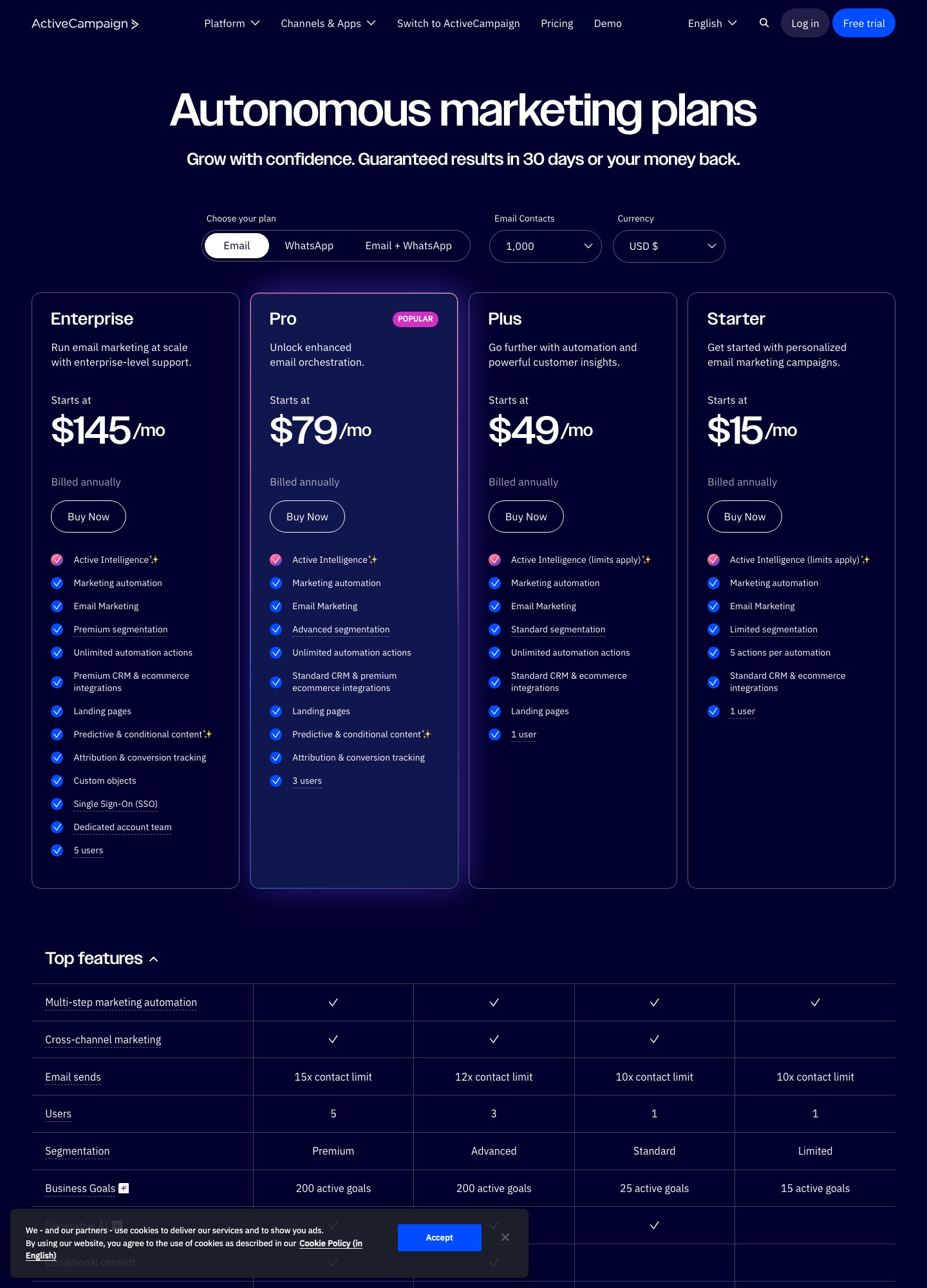
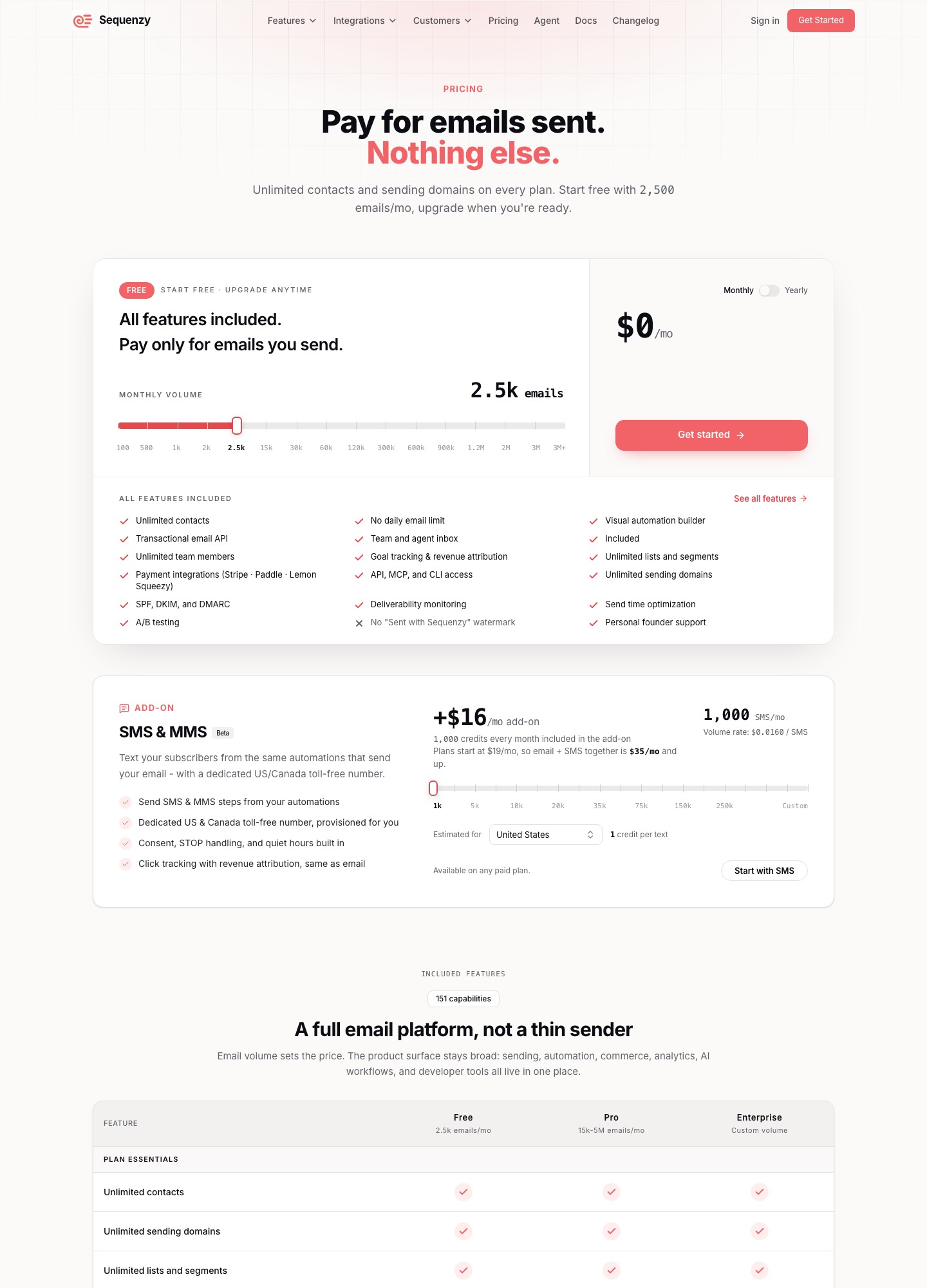
The two prices are not measured in the same unit, so the table rests on an assumption that is ours: each subscriber receives 4 emails a month, and one subscriber is one contact. That makes 4 x 1,000 = 4,000 sends, 4 x 5,000 = 20,000 and 4 x 10,000 = 40,000. Sequenzy charges for the smallest tier that covers the sends; ActiveCampaign charges for the contact count its selector is set to.
| Subscribers | Sends at 4 each | Sequenzy | ActiveCampaign Starter | ActiveCampaign Plus | ActiveCampaign sends allowed (10x contacts) |
|---|---|---|---|---|---|
| 1,000 | 4 x 1,000 = 4,000 | $19 a month (4,000 is above the free 2,500, so the 15,000-email tier) | $15 | $49 | 10 x 1,000 = 10,000 |
| 5,000 | 4 x 5,000 = 20,000 | $29 a month (the 30,000-email tier) | $79 | $145 | 10 x 5,000 = 50,000 |
| 10,000 | 4 x 10,000 = 40,000 | $49 a month (the 60,000-email tier) | $149 | $189 | 10 x 10,000 = 100,000 |
All figures are dollars per month. The ActiveCampaign figures are the contact-selector readouts on its pricing page for the email plans, billed annually. Sequenzy's page also lists yearly prices of $205, $313 and $529 for the 15,000, 30,000 and 60,000-email tiers. Starter also means 1 user and the 5-action automation cap, so anyone building longer flows should read the limit on the next plan up before treating Starter as the match.
What changes if you send more or fewer emails
The 4-a-month assumption favours neither tool by design, and moving it shifts the result because only one of the two prices follows sends. ActiveCampaign's bill stays where it is for as long as the sends fit inside the allowance in the last column. Sequenzy's moves with each tier boundary.
| Scenario | Sends | Sequenzy | ActiveCampaign Starter |
|---|---|---|---|
| 1,000 subscribers, 2 emails each | 2 x 1,000 = 2,000 | $0 (inside the free 2,500) | $15 |
| 1,000 subscribers, 10 emails each | 10 x 1,000 = 10,000 | $19 | $15 (10,000 is the full allowance) |
| 5,000 subscribers, 8 emails each | 8 x 5,000 = 40,000 | $49 | $79 |
| 10,000 subscribers, 1 email each | 1 x 10,000 = 10,000 | $19 | $149 |
| 10,000 subscribers, 7 emails each | 7 x 10,000 = 70,000 | $99 (the 120,000-email tier) | $149 (inside the 100,000 allowance) |
Read across the rows: a small list mailed often is where ActiveCampaign's flat contact price pays off, and a big list mailed lightly is where Sequenzy's volume price does. If your ActiveCampaign list also holds people you never email, its contact count, and so the bill, is higher than your subscriber count; Sequenzy's price ignores contacts altogether. We did not price a sends overage on either side because neither page we read states one.
Which tool for which team
Choose ActiveCampaign if
- Reps work deals daily and you want pipeline stages, lead assignment and tasks in the same system as the email flows.
- Your flows run past 5 actions, so Starter is out, and you want conditional content and deeper segmentation as you go up the plans.
- You email the list often and want the bill to stay put while sends stay inside the 10x allowance.
- Your stack is Shopify or WooCommerce on the commerce side, or Salesforce or Microsoft Dynamics on the CRM side, all on its integration list.
Choose Sequenzy if
- You are a SaaS team on Stripe, Paddle or Lemon Squeezy and want subscription events to start the flows.
- A failed payment should send a dunning email with a card-update page, and you are happy for Stripe or Paddle to keep the retry rules.
- Your list is large and the mailing light: 10,000 subscribers sent once a month is 10,000 sends and the $19 tier.
- You want to start on a free plan with 2,500 emails, every feature and no credit card, then pay by volume.
Use neither if
- You want a whole sales and marketing suite and are weighing ActiveCampaign against a bigger platform: read HubSpot vs ActiveCampaign.
- You run a service business that needs invoices, payments and booking beside the follow-up emails: Keap vs ActiveCampaign covers that trade.
- Your emails depend on in-app events more than on billing: Customer.io vs Loops compares two tools built around product events, and the trial conversion guide shows what such a flow needs.
- You are leaving ActiveCampaign for another reason entirely: the ActiveCampaign alternatives page lists the options.
Moving between them
Neither vendor page we read describes an import tool or a one-click migration, so treat both directions as an export followed by a hand rebuild. Check each vendor's help centre for the export formats it offers, because this page did not verify them.
From ActiveCampaign to Sequenzy
- Export while you still can. Contacts with their tags, custom fields and list membership; unsubscribes and bounces as a separate file; the deals with stage, owner and value; and a written map of every automation giving its trigger, waits, conditions and actions.
- Re-point the triggers. An ActiveCampaign automation that starts on a form or a tag has to start on a Sequenzy event instead, such as a Stripe, Paddle or Lemon Squeezy subscription event, or one you post yourself.
- Rebuild by hand. Each automation becomes a flow in Sequenzy's visual builder. The segments you relied on need recreating, and Sequenzy's homepage describes segments built from plan, MRR and engagement data.
- Find a home for the CRM steps. Steps that create a deal, assign a rep or send a notification have no counterpart in Sequenzy's feature list, and neither does lead scoring. Send those events to your CRM through Zapier or a webhook, or drop them.
- Rebuild the dunning flow last. Connect the payment provider, confirm that
invoice.payment_failedreaches Sequenzy, and send yourself the card-update email before real customers see it. - Keep ActiveCampaign until the new flows have sent. Its prices are quoted as billed annually, so check your renewal date before planning the cutover.
From Sequenzy to ActiveCampaign
- Export the subscriber data with its attributes. Plan, MRR and engagement fields become ActiveCampaign custom fields, and they only help if something keeps writing them after the move.
- Settle the event route first. Because the pricing page names no payment-provider triggers, prove in the free trial that a failed-payment or cancellation event can start an automation, through Zapier or its API, before you cancel anything.
- Count actions per flow. A dunning sequence with several emails, waits and a tag change may not fit Starter's 5-action cap; price the plan the flow needs.
- Import fewer contacts. ActiveCampaign's price follows the contact count, so leave out dormant addresses that Sequenzy carried at no cost.
- Set up the pipeline last. Define the deal stages in the CRM, then add the automations that create deals and notify reps; this is the part Sequenzy had no equivalent for.
Frequently asked questions
Is Sequenzy cheaper than ActiveCampaign?
It depends on list size and on how often you send. With 4 emails per subscriber a month, the Sequenzy $29 tier covers 20,000 sends and its $49 tier 40,000, while 4,000 sends sit on the $19 tier. ActiveCampaign Starter reads $15 at 1,000 contacts, $79 at 5,000 and $149 at 10,000, so Starter is the cheaper plan only at the smallest size. A small list mailed often can favour ActiveCampaign, and a large list mailed rarely favours Sequenzy.
Does Sequenzy include a CRM or a deal pipeline?
Nothing in the feature list on Sequenzy's pricing page is a CRM: it names a visual automation builder, goal tracking, revenue attribution, AI-generated sequences and a transactional email API. Zapier and custom webhooks are on its integration list, so deals can live in a separate CRM that those feed. If reps need pipeline stages, lead routing and tasks next to the email flows, ActiveCampaign's CRM page lists them.
Can ActiveCampaign send a dunning email when a Stripe payment fails?
ActiveCampaign's pricing page does not name payment-provider triggers and we have not confirmed a native one, so we claim nothing either way. Zapier is on its integration list, which is one way to pass an event in; test your exact event during the free trial before choosing a plan. Sequenzy documents this case directly: a Stripe invoice.payment_failed event starts a dunning email with a card-update page, while the retries stay in Stripe or Paddle.
Can I move my ActiveCampaign automations into Sequenzy?
Neither vendor page we read describes an automation import or a one-click migration, so plan to rebuild each automation by hand in Sequenzy's visual builder. Export what you can from ActiveCampaign before cancelling: contacts with tags and custom fields, a written map of every automation, and the deals. Deals need a new home, because Sequenzy's feature list has no deal pipeline.