Sequenzy vs Drip: Store vs Subscription Events
Sequenzy vs Drip, disclosed: store-event vs subscription-event automation, send-volume vs list-size pricing, with costs at 2,500, 5,000 and 10,000 people.
We still say where Drip is stronger. Prices come from each vendor's own pricing page, read on 7 Oct 2026; see how we evaluate.
Drip is the better fit for online stores that want automation driven by browsing, carts and orders, with revenue attribution, and it prices by the number of people on the list. Sequenzy is the better fit for SaaS teams whose triggers are subscription and payment events from Stripe, Paddle or Lemon Squeezy, and it prices by emails sent, with unlimited contacts. The two overlap more than their reputations suggest, since Sequenzy's pricing page also lists Shopify, a WooCommerce plugin in beta and abandoned cart recovery. The deciding questions are what your triggers are made of, and whether your bill should follow your list or your sending.
What starts an automation: a cart or a subscription
Both products run workflows that start on an event, wait, branch and send. They differ in which events arrive ready-made. Drip's pricing page describes segmentation "that follows what people actually do. Browsing, buying, returning, going quiet", and its FAQ says it is "built specifically for ecommerce", while adding that you do not need a store to use it. Sequenzy's homepage describes connecting Stripe or PostHog once, or posting your own events, so that each event starts a flow for a segment built from plan, MRR and engagement data.
| Sequenzy | Drip | |
|---|---|---|
| Centre of gravity | Subscription and payment events, plus a commerce set | Store behaviour: browsing, carts, orders |
| What the bill follows | Emails sent per month; unlimited contacts on every plan | Active people on the list, and the volume of emails sent in the month |
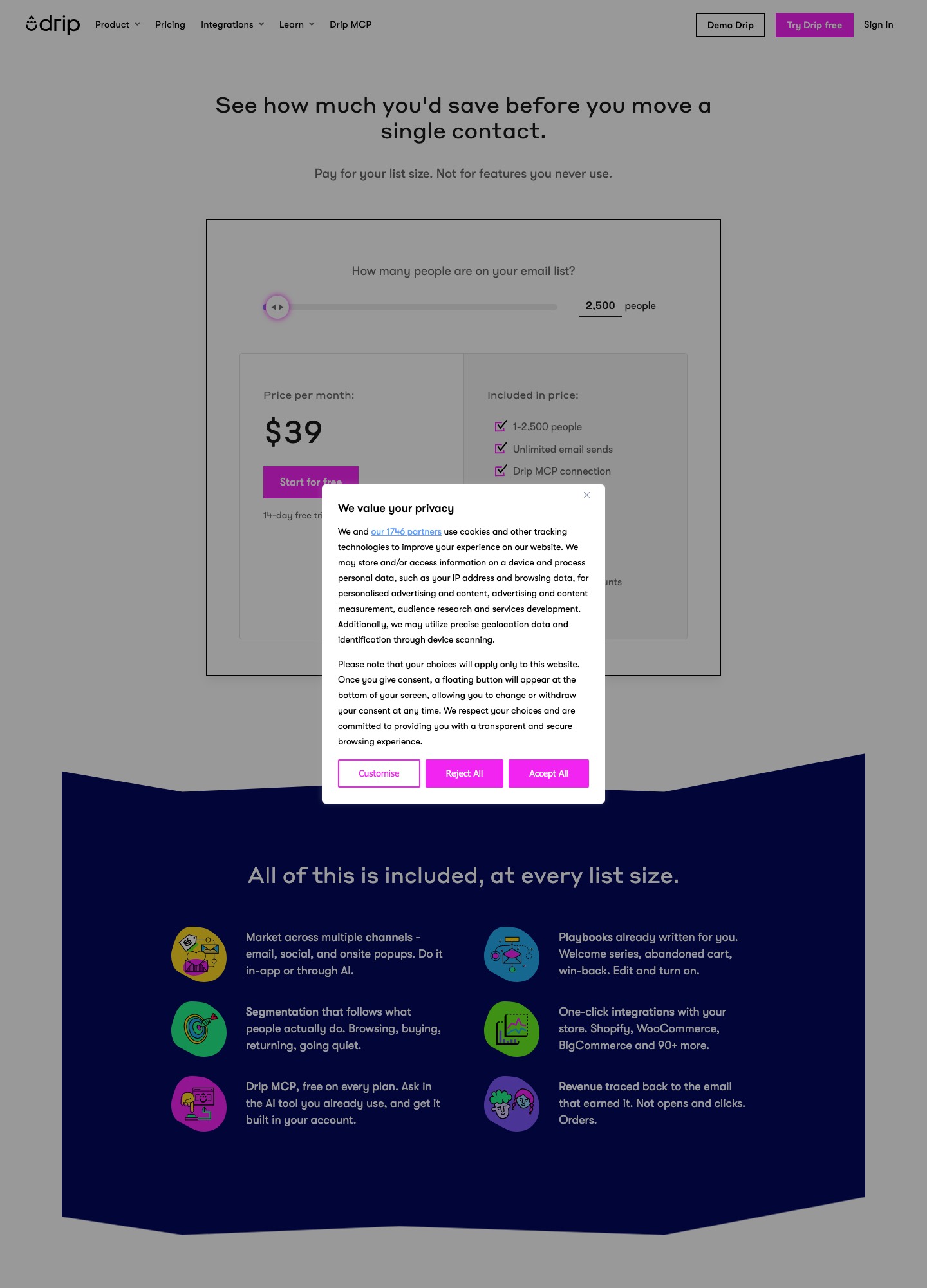
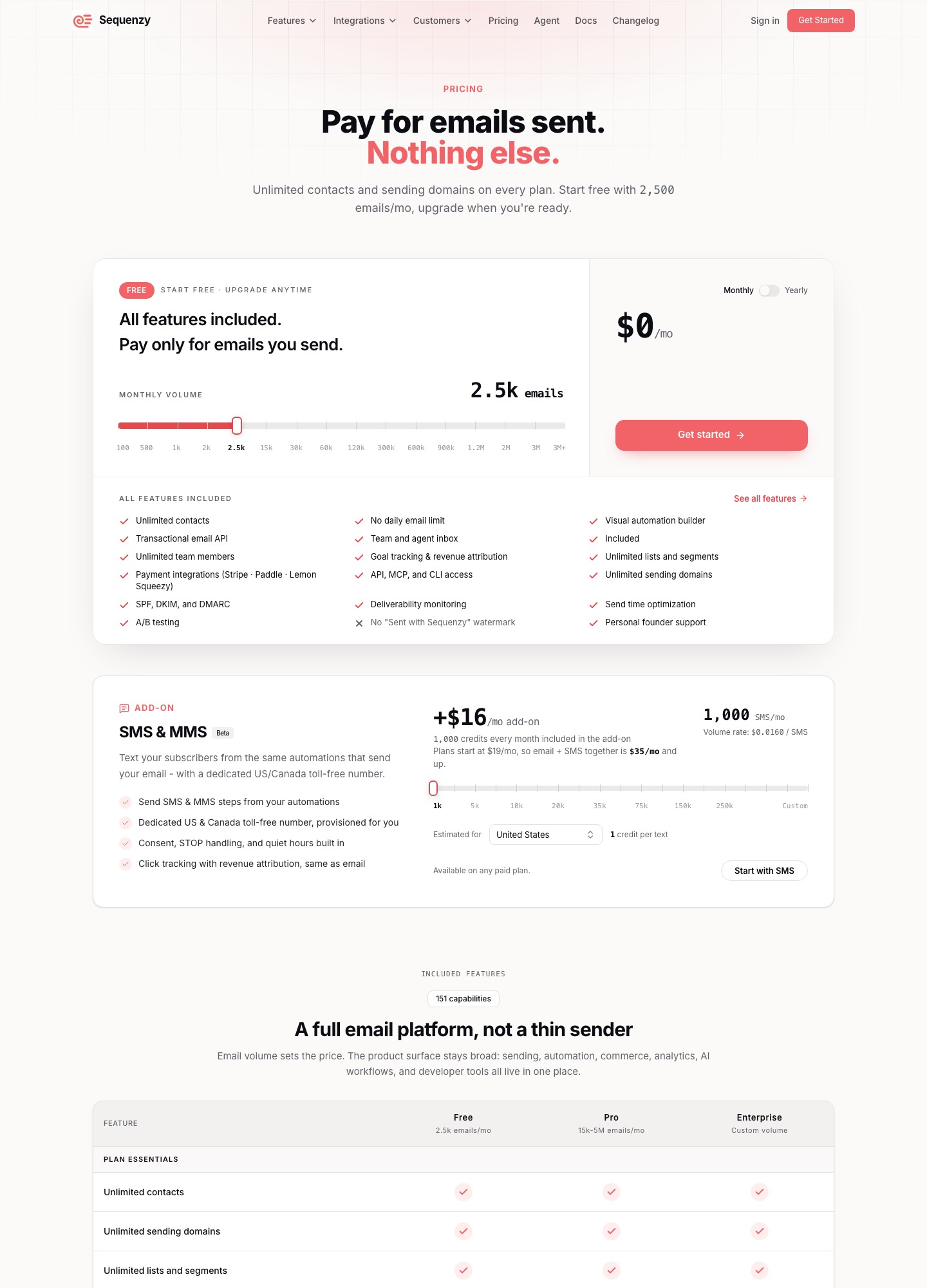
| Lowest published price | Free at 2,500 emails a month; $19 for 15,000 | $39 for 1 to 2,500 people, after a 14-day trial |
| Free option | Free plan with every feature, no card | 14-day trial, no card; no ongoing free plan |
| Integrations named | Stripe, Paddle, Lemon Squeezy, Shopify, WooCommerce (beta), Zapier, webhooks and more | Shopify, WooCommerce, BigCommerce, Stripe, Typeform, Zapier |
| Revenue attribution | Included, with goal tracking | Ecommerce revenue attribution |
| Onsite pop-ups | Popup widgets and signup forms to capture subscribers onsite | Onsite campaigns in the displayed plan, described as a channel next to email and social |
| Transactional email | API included on every plan | Billed within the monthly usage |
| SMS | Add-on at $16 a month with 1,000 credits, paid plans | Available, at extra cost |
The right-hand column of every row is what Drip's pricing page says; the left is from Sequenzy's. Sequenzy's popup and forms entries come from the feature list on its own site, not from the plan table.
Where Drip is the stronger choice
Drip's whole product is organised around a shop. That shows up in five concrete places.
- Browse and cart behaviour as triggers. Drip names browsing, buying and returning as the signals its segments follow. Sequenzy's commerce list covers abandoned carts, post-purchase sequences, back-in-stock, replenishment reminders, purchase-based segments and win-back, but it does not name browse behaviour.
- Onsite campaigns as a core channel. Drip's displayed $39 plan includes onsite campaigns, dynamic segments and up to 50 workflows, and its pricing page presents onsite pop-ups as a channel next to email and social. Sequenzy also lists popup widgets that capture subscribers onsite, so compare the two on your own use case, such as whether the pop-up should react to what a visitor has browsed.
- Platform depth. Drip lists Shopify, WooCommerce and BigCommerce, and its pricing page counts 90+ integrations. Sequenzy lists Shopify and a WooCommerce plugin that is still in beta, and BigCommerce does not appear on its pricing page.
- Ecommerce revenue attribution. Both list revenue attribution. Drip describes its as ecommerce revenue attribution, and its trial FAQ promises revenue dashboards once your store is connected; Sequenzy's sits alongside custom goal tracking and configurable attribution windows. If your question is "which email earned this order", Drip is the one that frames it around orders.
- Sends that do not count against you at a given list size. The $39 plan includes unlimited email sends, and the readouts up to a 30,000-person list say the same. A store that mails a big list daily with promotions never meets a send ceiling there. The ceiling does appear on the largest readouts: the 40,000-person reading includes 480,000 sends, and the 50,000-person reading includes 600,000, which is 12 emails per person in both cases (480,000 / 40,000 and 600,000 / 50,000).
Where Sequenzy is the better fit
Sequenzy is built around the moment a subscription changes. Its homepage says a failed Stripe invoice.payment_failed event starts a dunning email flow with a card-update page, and that new subscriptions and cancellations can start onboarding and win-back sequences. The retry schedule itself stays in Stripe or Paddle; Sequenzy sends the emails. Its pricing page lists Stripe, Paddle and Lemon Squeezy integrations, with Stripe segments by MRR and LTV, plus PostHog, Clerk, Supabase webhooks and custom webhooks for your own product events.
The pricing model suits that audience. A SaaS list is often mostly free-trial users and quiet accounts, and Sequenzy bills emails sent with unlimited contacts, so a growing list costs nothing until you mail it more. It has a free plan with 2,500 emails a month and every feature, a transactional API for password resets and receipts next to the marketing sends, and AI-generated sequences and campaign drafts on every plan. Drip has no ongoing free plan and bills transactional email within its monthly usage. On the AI side both offer an MCP connection for AI clients, which Drip's pricing page calls Drip MCP, free on every plan.
Two caveats on Sequenzy's side. The free plan keeps a "Sent with Sequenzy" watermark that paid plans remove. And Drip does list Stripe among its integrations: we did not find a description of what Drip does with subscription events, so a SaaS team that likes Drip for another reason should test a Stripe-triggered flow in the 14-day trial before assuming it cannot be done.
The bill: people on the list versus emails sent
Drip's pricing page says the cost "is based on the number of active people in your account and the volume of emails you send during the month", and its slider reprices as the list grows. Sequenzy ignores the list and counts sends. Comparing them needs an assumption about how often you mail each person, so here is ours: 4 emails per person per month, which is a weekly newsletter or a mix of campaign and automation sends. It is our assumption, not a figure from either vendor, and the next section shows what happens when it is wrong.
| People on the list | Sends at 4 each | Sequenzy tier | Drip slider | Difference |
|---|---|---|---|---|
| 2,500 | 4 x 2,500 = 10,000 | $19 (15,000 emails) | $39 | Drip costs $20 more (39 - 19) |
| 5,000 | 4 x 5,000 = 20,000 | $29 (30,000 emails) | $89 | Drip costs $60 more (89 - 29) |
| 10,000 | 4 x 10,000 = 40,000 | $49 (60,000 emails) | $154 | Drip costs $105 more (154 - 49) |
All figures are US dollars per month. Sequenzy's tiers are $19 for 15,000 emails, $29 for 30,000, $49 for 60,000 and $99 for 120,000; a send count rounds up to the next tier. Drip's slider also reads $49 at a 3,000-person list, $124 at 7,500, $209 at 15,000, $289 at 20,000, $369 at 25,000, $449 at 30,000, $609 at 40,000 and $699 at 50,000, where the button changes to Book a demo. What you get does not change across the three rows: unlimited sends at those list sizes, dynamic segments, onsite campaigns and up to 50 workflows on Drip's displayed plan, and every feature on every Sequenzy tier.
When a heavier sending habit changes the answer
The gap above depends on the 4-a-month habit. Raise it and Sequenzy climbs tier by tier while Drip does not move, because Drip's price is set by the list.
- 10,000 people at 12 emails each. 12 x 10,000 = 120,000 sends, which is Sequenzy's $99 tier. Drip's slider reads $154 for the same 10,000 people, so Sequenzy is still $55 cheaper (154 - 99). Sequenzy's published tiers stop at 120,000 sends, so we cannot say how its next price compares with Drip's $154; ask before you plan beyond it.
- 5,000 people at 13 emails each. 13 x 5,000 = 65,000 sends, which is past the 60,000 tier and lands on the $99 tier. Drip reads $89 at 5,000 people, so Drip is $10 cheaper (99 - 89). At 12 emails each, 60,000 sends is still the $49 tier.
- 2,500 people at 13 emails each. 13 x 2,500 = 32,500 sends, which is past the 30,000 tier and lands on the $49 tier. Drip reads $39 at 2,500 people, so Drip is $10 cheaper (49 - 39). At 12 emails each, 30,000 sends is the $29 tier.
So the crossover is a small, heavily mailed list. A store that sends daily promotions to 2,500 people is the case where Drip's flat list-size price wins on the pricing pages.
A big list that is mostly quiet
Sequenzy has no per-contact price, so a large list that you rarely mail costs very little. Take 50,000 people who receive one email a month: 1 x 50,000 = 50,000 sends, which fits the $49 tier of 60,000. Drip's slider reads $699 for a 50,000-person list, a $650 difference (699 - 49). At 4 emails each the same list is 200,000 sends, which is above the largest Sequenzy tier we could read, so the saving is only large while the sending stays low. A big list full of people who never open is still a deliverability risk, whoever bills it.
Who should pick which
Pick Drip if you run a store
Choose Drip if you sell through Shopify, WooCommerce or BigCommerce and want orders, carts and browsing to drive both the sequences and the revenue reports. It also wins the pricing pages for a small, heavily mailed list, the 2,500-person case above.
Pick Sequenzy if you sell a subscription
Choose Sequenzy if you bill through Stripe, Paddle or Lemon Squeezy and want payment events to start onboarding, dunning email and win-back flows, and your list is mostly trial users and quiet accounts that a send-based price handles cheaply. You can start on the free 2,500-email plan.
Use neither if the job is something else
Drip says an online store is not required, but it is built for ecommerce, and Sequenzy is built around subscriptions. A creator selling a newsletter or courses is better served by a tool designed for that; our ConvertKit versus Drip page covers that angle. A SaaS team that needs sequences driven by what users do inside the product should read Customer.io versus Drip and Loops versus Drip, and a team whose emails hang off a sales CRM should read ActiveCampaign versus Drip. If you came here because Drip is not working for you, Drip alternatives is the wider list.
Moving between them
Leaving Drip for Sequenzy
Start with what Drip's help article on exporting data says it can hand over. A people export (People, Active, then Actions, Export to CSV) arrives by email as a CSV with the address, status, tags, email series campaign names, lead score, lifetime value, user ID and custom fields. An account export covers templates, the people list and email series campaigns. The same article says that emails created with the visual email builder and events are not exportable.
- People, tags and custom fields. Export them and keep the tags: they are your segment map. Sequenzy's pricing page lists bulk CSV import and custom attributes such as MRR and plan, so map tags and fields onto those. We did not find a Drip-specific import tool on Sequenzy's pages, so plan on a CSV import.
- Unsubscribes first. The export path starts at the active list and the file carries a status column, so confirm that unsubscribed people travel with it and are loaded before anyone else is mailed.
- Workflow maps. Neither export list includes workflows, so document each one by hand (trigger, waits, branches, exit rules) before you cancel. Expect to rebuild them in Sequenzy's visual automation builder.
- Store sync. If the store stays, Sequenzy lists a Shopify integration with product catalog, customer and order sync, and a WooCommerce plugin in beta. There is no BigCommerce entry, and browse-driven segments have no listed counterpart.
Leaving Sequenzy for Drip
The reverse move is a CSV out and a rebuild in. We did not read Sequenzy's export documentation, so check there which fields leave with your subscribers, and keep a copy of every sequence's trigger and exit rules. Drip's pricing page lists "Free migration" and "Personalized onboarding" among what the displayed plan includes and links a migration service page, which is worth asking about before you start. The piece with no equivalent to bring across is the failed-payment flow: a Sequenzy dunning email started by invoice.payment_failed with a card-update page needs a replacement, whether that is Stripe's own customer emails or a Drip workflow you have confirmed can be triggered by the Stripe connection. Before moving a list that is priced by emails sent to one priced by people, run the arithmetic from the cost section with your real list size.
Frequently asked questions
Is Sequenzy or Drip cheaper?
On the vendors' pricing pages, Sequenzy costs less at every list size we priced, as long as you send a moderate number of emails per person. At 4 emails per person a month, 10,000 people means 40,000 sends, which is Sequenzy's $49 tier against $154 on Drip's slider. The order flips for a small list that is mailed very often: 2,500 people at 13 emails each is 32,500 sends, which needs Sequenzy's $49 tier, while Drip stays at $39.
Can Drip run SaaS subscription emails?
Drip lists Stripe among its integrations, so a subscription business can connect to it, and its FAQ says an online store is not required. Its pricing page does not describe subscription triggers such as a failed-payment dunning flow, though, and it says the product is built specifically for ecommerce. Before moving a SaaS list there, confirm that the billing events you need actually reach Drip and can start a workflow.
Can Sequenzy replace Drip for an online store?
Partly, and you should test it against your own flows first. Sequenzy's pricing page lists a Shopify integration, a WooCommerce plugin in beta, abandoned cart recovery, post-purchase sequences and purchase-based segments. It does not name BigCommerce or browse behaviour, so a store that leans on browsing data or on a platform outside Shopify and WooCommerce should check those gaps before switching.
Which one has a free plan?
Sequenzy does: 2,500 emails a month with every feature, no card required, though the "Sent with Sequenzy" watermark is only removed on paid plans. Drip offers a 14-day free trial with no card and no ongoing free plan, and its FAQ says unlimited email sending is not available during the trial. If you want to keep a small list running for nothing, only Sequenzy does that.